Software Development Automation Beyond CI/CD
Software development automation extends past CI/CD pipelines. Discover how local agent orchestration and sequential chains deliver supervised, reviewable
A developer finishes the third prompt. They paste the last output into a new session and wait for the next agent to catch up. This work happens every day. That makes it worth fixing. Software development automation does not have to mean wiring the sequence into a pipeline that runs after each commit. A person can deliberately run a short, supervised chain once, watch every step, and stop as soon as any part goes wrong.
Why Pipelines Are Not the Only Answer
Background automation is the first impulse. It fails in this case. AuricIDE handles automation as a local run that a person starts and supervises, so that person remains responsible for the result.
Developers who copy prompts between fresh sessions already run the sequence by hand. A webhook will not fix that. They need a sequence that keeps enough context for the next step without treating messy work as a predictable process. A separate look at developer productivity tools fits that framing better than any pipeline slogan.
Practical rule: Keep a person in control when the next step needs human judgment.
The pipeline argument misses the failure. Repeated work costs time, but broken continuity causes more trouble. A pipeline may start on time every time while still handling the wrong kind of task. Some chains need a person to decide whether the work should continue.
How Do Sequential Agent Chains Execute?
AuricIDE calls a chain a combo. Each combo is an ordered list of skills, and every step chooses its own agent, model, and permission mode. A person clicks to start the run. The steps then run in order. Nothing fans out. No parallel branch or second path starts in the background.
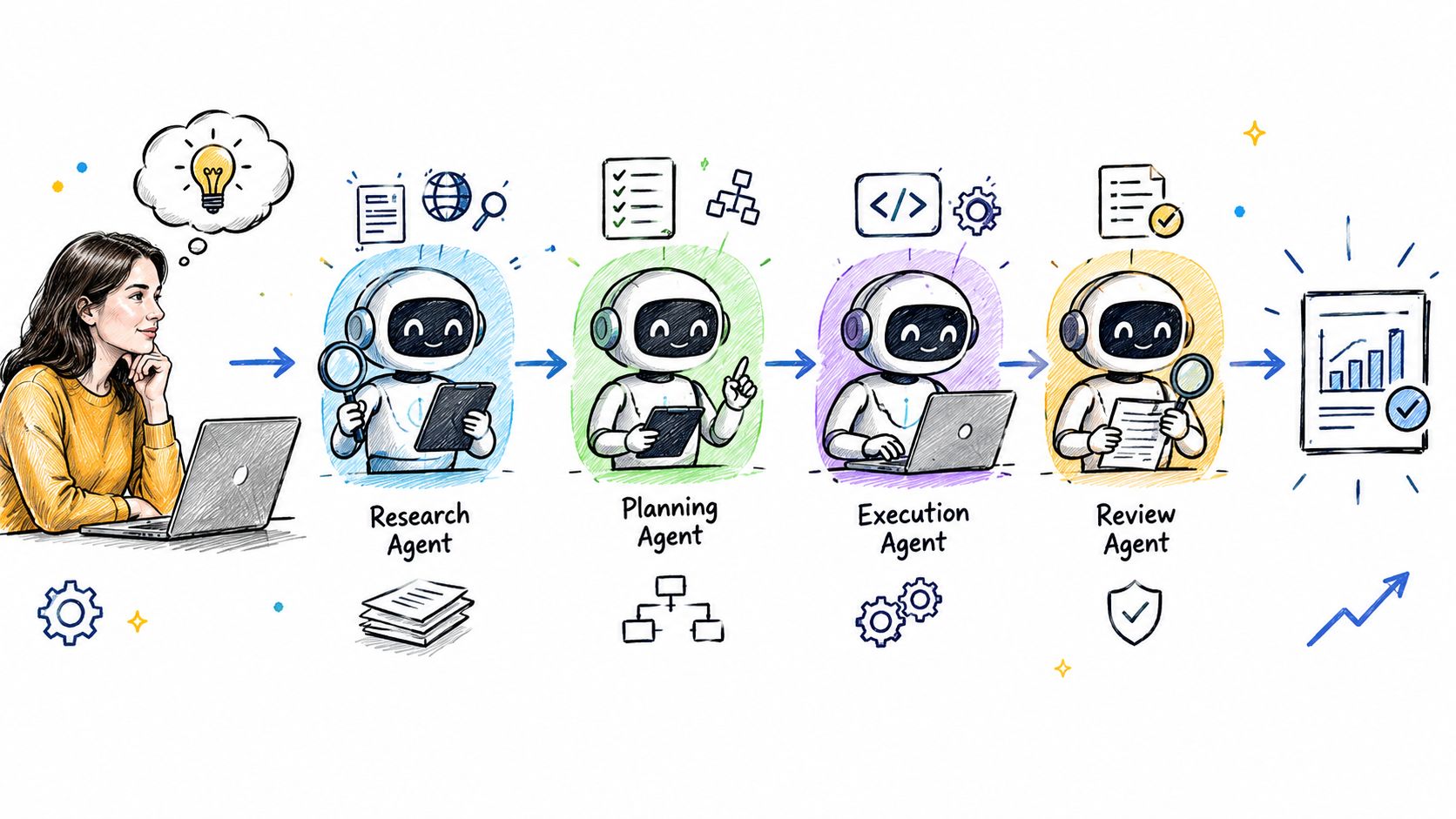
The handoff makes the chain useful. Each step gets its own prompt and a cleaned terminal tail from the step before it. AuricIDE strips ANSI codes, removes interface chrome, merges repeated spinner lines, and caps the result at 2000 characters, working backward from the newest line. The next agent sees what just happened without digging through a pile of noise.
What the tail keeps
The tail keeps the useful end of the last run: the error line, last command, final warning, and context the next step needs.
The broader multi-agent layout only works because each step gets a clean boundary. A crowded session is like a desk covered in receipts. The correct one is there, but it takes time to find.
Why sequence matters
The sequence gives the operator a clear place to stop, because step three never receives a broken assumption or makes the problem larger when step two fails.
Each step waits for the last. Later steps cannot move ahead of the available evidence.
What Are the Trade-Offs of Local Orchestration?
AuricIDE scopes each chain to one project by design. The project record lives in a SQLite file inside the project directory. AuricIDE keeps that file out of Git by default. A clone does not include the work record. A second repository remains outside the chain.
This setup makes sharing harder. It also keeps the boundary clear. One chain cannot span two repositories, which can be awkward when a single change set crosses that line during one development task. In that case, developers need two runs or separate agents working side by side in the fleet view.
A chain that spans everything soon owns nothing.
AuricIDE stops the whole chain when any step fails. The next step never receives a broken result that looks like valid input. This rule saves review time.
The local model also has a privacy trade-off. Code and context stay on the machine, which suits teams that want supervised work instead of a remote handoff. The operator must manage each run. Managing the run takes some effort. Untangling a bad automated branch takes more.
Background Triggers or Supervised Runs?
A background trigger fits predictable work that should start when an event arrives. A supervised run fits messy work where the operator needs to inspect each step and stop after a bad result.
AuricIDE uses supervised runs. It starts agents locally as PTY child processes. AuricIDE stores shared project state over MCP. The operator stays close instead of sending the whole flow to a remote job queue. Together, these parts create a meta-harness, a local wrapper around the wrappers.
Operational rule: Keep the run visible when someone must review a result before the next step starts.
CI/CD describes a different job. AuricIDE chains do not automate releases or act as pipeline stages. They organize local work into deliberate steps with clear boundaries. A bad result stops the process. It never keeps going just because a machine said so.
Solving the Governance Gap in Agentic Workflows
Review practices often lag behind the spread of AI-assisted code creation. Many teams already have capable tools and weak supervision. The governance problem concerns the route that generated work takes through a project. More output does not solve it.
AuricIDE controls that route with an explicit permission mode for each step, a capped terminal tail, and strict sequencing. Every step has limited input and a visible result. A failure stops the chain, so the run remains easy to review. Its monitoring view fits that same idea, since the operator can see what happened without trusting an invisible corridor of intermediate guesses.
The rule stays simple. Automation here means a sequence that a person chose to run, can review, and can restart. It has a narrower role than CI/CD by design. That role often fits exploratory, local work that still needs human judgment.