AI Agent Management Software: Where Handoffs Break
Compare AI agent management software on orchestration, integrations, local execution and team workflows, with a worked example from AuricIDE.
Three terminals are open on the same repository. One agent refactored a module, a second wrote tests, a third sits waiting on a question nobody answered. The only thing connecting them is a person scrolling back through output and pasting the useful part into the next window.
Copy and paste is doing the management work. Any piece of AI agent management software either takes that job over or leaves it with you, and the moment it takes over is the moment of transfer between one agent and the next.
Why Does the Second Agent Start from the Wrong Place?
Because the first step succeeded at its own job, and the chain passed that success forward as if it described the second step's job.
A composite case, not a recorded session. A weekday afternoon, one repository, two skills in a chain. Step one is a coding agent told to move billing into its own module. It changes fourteen files, skips two tests it could not load, and exits cleanly. The process reads as done.
Step two is a different agent. Its own prompt says to update the test file the refactor broke. What it sees first is the tail of step one's terminal:
14 files changed 2 tests skipped process exited: success
The second agent edits a helper module instead, prints a tidy summary, and exits with success as well. The skipped tests still fail on the next run.
The first step did what it was told. What it handed on described a process that ended well, not a repository that ended well, and the second agent treated those as the same statement. Nothing in step one looked like an error. The defect was in the handoff, where no error is ever raised.
Is a Smarter Agent the Fix for Bad Handoffs?
A stronger model still starts with whatever the handoff gives it. Its first reasoning step happens after the management layer has selected, cleaned, and bounded the prior output.
The capability explanation deserves a hearing before it gets rejected. Stack Overflow's 2025 Developer Survey reported that 31% of developers were currently using AI agents, 17% planned to use them, and 69% of developers who had used agents at work agreed the tools increased their productivity. Those figures show adoption and reported productivity gains while leaving the handoff problem intact. The same release identified trust as a major issue, with confidence in AI outputs weakening as usage expanded.
Model quality still matters. An agent that questions a tidy success summary will catch more than one that accepts every prior claim. The limit is evidence: no model can inspect a diff, failure detail, or skipped test that the chain never forwarded.
The handoff between steps decides what the next agent can see. Fleet software earns its place by deciding what gets passed forward and by making that decision visible.
Four criteria for judging AI agent management software
| Criterion | What to check | How AuricIDE handles it |
|---|---|---|
| Orchestration | Who picks the agent for each step, and what happens when a step fails | Ordered chains of skills; each step selects its agent, an error exit ends the chain, and errors rank first in the attention count |
| Integrations | How a new agent CLI gets registered, and whether it needs a rebuild | Agent CLI JSON files can be placed in a directory or imported from settings; only Crush is compiled into the binary, while other CLIs register without restarting or maintaining a plugin API |
| Local execution | Where agent processes run, and where project data is stored | Agents run as local PTY child processes and report real exit codes; project data sits in a SQLite file inside the repository |
| Team workflows | How agents and people share the backlog and requirements | Goals, tickets, requirements, test cases, dependencies and history are exposed over MCP |
Run all four checks against a repository that already has two agents. Look for error exits that stop a chain, limited dispatch retries with timestamped decisions, and controls that park one agent or the whole fleet. Those controls make the handoff inspectable. Model upgrades remain worthwhile, but they happen downstream of the layer that decides which evidence reaches them.
How Does a Chain Pass Context to the Next Agent?
A chain passes context through one artefact: the raw standard output of the step that just ran, delivered to the next step as a terminal tail. No vendor-specific envelope wraps it, so a step running in one CLI can hand off to a step running a different one.
- Run. The skill starts as a local PTY child process, and the app reads its real exit status. A crash surfaces as an error rather than an agent sitting idle, and a step that exits with an error ends the chain.
- Pass. The next step starts with its own prompt, then the tail of whatever the previous process printed. The tail arrives labelled as raw and possibly truncated, which gives the receiving agent a reason to verify the result instead of trusting it.
- Rank. A failed step sorts above blocked-on-input, which sorts above stalled, in a single attention count. A broken handoff lands at the top of the queue, not buried under healthy agents.
Those three stages are what the diagram below shows end to end, from the first agent to the last.
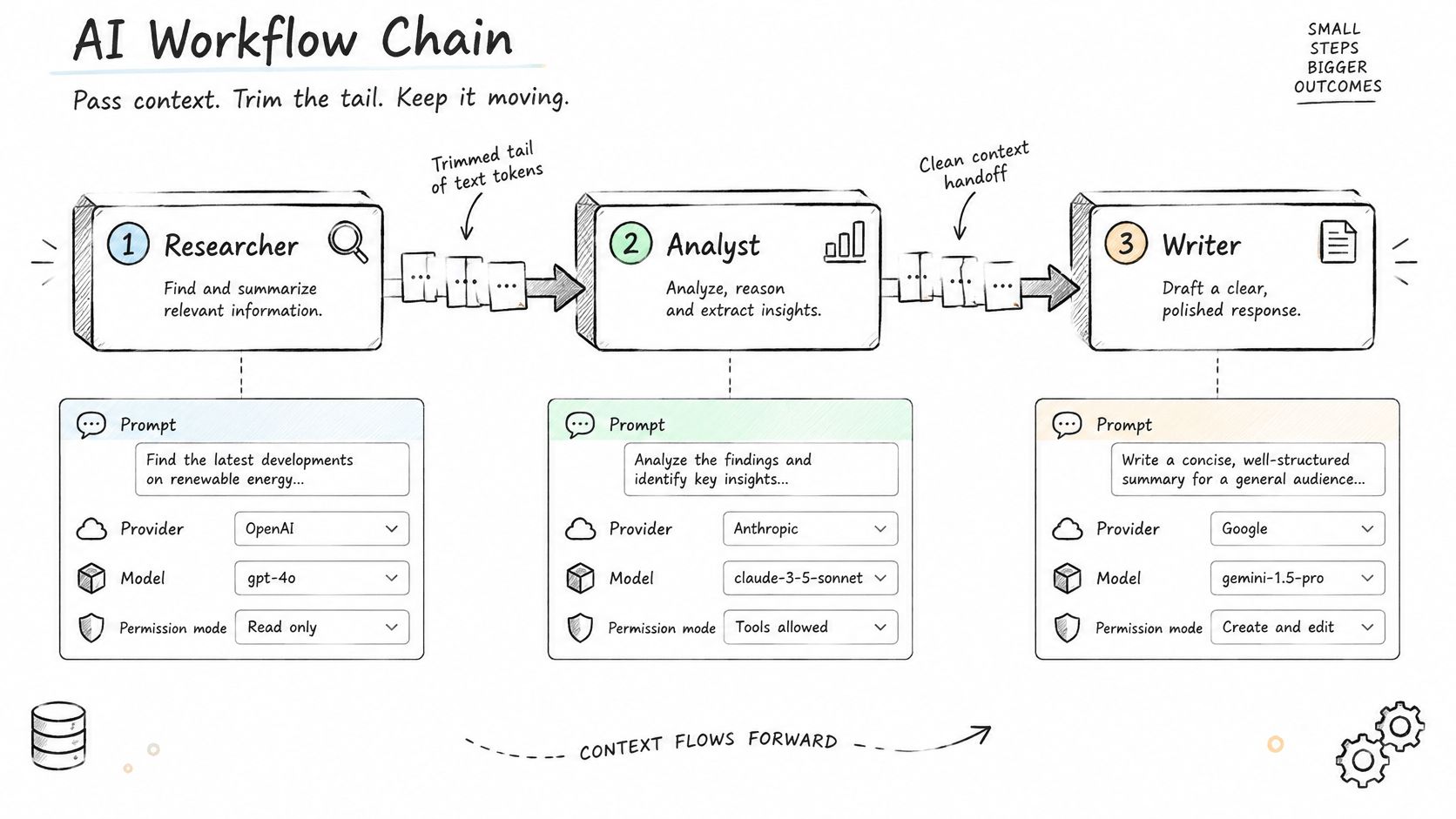
Truncation is where most of the loss hides. When output runs longer than the tail holds, the earlier lines never reach the next step, and nothing reports the part that got dropped. A long test run ends with a summary at the bottom, which survives. The diff explaining why a test failed sits above it, which doesn't. That ordering is exactly why the label matters. An agent that treats the tail as the complete record repeats the failure at full confidence. An agent that re-runs the check or opens the file costs a few extra calls and catches it.
Developers already know this cost. Research deposited with North Carolina State University found that 58% rated tracking changes across files, sessions or agents as very or extremely demanding, and 41% reported agents claiming completion while work stayed broken. How context is carried between agents decides whether a tail reads as evidence or a rumour.
How Does a New Agent CLI Join the Fleet?
One JSON file per CLI, registered without a rebuild or a restart. Crush ships compiled into the binary; every other agent CLI is described by a JSON definition the app reads when it registers the file.
- Write a single JSON file describing the CLI: how it launches, what it is called, which mode it runs in.
- Register it one of two ways. Drop the file into the configured directory, or import it from settings. Either path takes effect without restarting the application.
- Attach the provider to a skill once the file registers.
Validation is strict. One missing field rejects the entire file, and the reason gets written to stderr. A typo costs a round trip, not an afternoon of guessing.
The limit is narrower than it looks. A provider can do what the schema describes and nothing more, because registration is configuration rather than a plugin API. Behaviour outside that vocabulary needs a change to the app itself. The trade is deliberate: a fixed set of fields you can check, instead of arbitrary code you have to trust. On that model, adding an agent through the integration path is a config file and a passing schema check, and it costs no code.
What Does Keeping Fleet State Local Cost?
Shared visibility. The record stays on the machine that ran the fleet, so a teammate sees only what someone commits.
Agents run as local child processes over a PTY, and project data goes into a SQLite database inside the repository rather than a cloud service. Keeping state local is a deliberate trade: the team controls the record and gives up automatic sharing of it. The timestamped decision log lives in that same store, so the audit trail is only as public as the repository makes it.
A local record travels with the repository. Whatever stays uncommitted stays invisible.
The same state is exposed over MCP: goals, tickets, requirements, test cases, dependencies and history, readable and writable by any client that connects. Two people on two machines still hold two databases unless the repository carries one to the other. Local AI agents covers where that boundary bites.
A SQLite file answers where the record lives and says nothing about what the fleet spent. Cost visibility is a separate accounting problem that local state does not solve, and the decision log tracks what was dispatched rather than what it cost. I'd treat anything the next agent or the next teammate needs to see as something that has to be committed, because local storage makes visibility opt-in. The software is licensed under AGPL v3 and ships as alpha, so the licence and the breaking changes, missing features and rough edges it warns about are part of the price too.
Should Your Team Run a Fleet Yet?
McKinsey's 2025 State of AI survey found 23% of organizations scaling an agentic AI system in at least one business function and a further 39% experimenting, with most of those scaling running it in only one or two functions. Narrow rollout is how fleets normally start.
One agent on one small repository gains little from a fleet view. Chains and an attention count add setup, and a single agent already finishes the work. The case for a fleet appears when several agents work one backlog and the handoffs between them cost real rework.
Start smaller than feels satisfying:
- Pin the repository as a tile so the fleet has an address.
- Write two skills, each with its own prompt and provider.
- Build one two-step chain with those skills.
- Read the terminal tail after the first run, then check the attention order before adding a third step.
That first run shows what the second agent received. The tail is labelled raw and possibly truncated, so the next step verifies the result instead of trusting it. AuricIDE can also dispatch agents to unblocked tickets, sorting them by dependency and priority, limiting retries, and writing each decision to a timestamped log.
The second agent only sees what the handoff gives it. A fleet that records that handoff and lets you inspect it beats a smarter model working from nothing.
AuricIDE is an open-source desktop IDE that runs CLI coding agents as a fleet and treats each handoff as a decision you can inspect, with ordered chains, a cleaned terminal tail passed between steps, and one attention count that puts failures first. If the argument above holds, the next useful test is a two-step chain on a repository you already know. Start at AuricIDE and read the first tail before you add a third agent.