Code Automation Tools for Local-First Agent Workflows
Explore code automation tools that run locally, from templating to refactor bots and agent fleets, with practical tips for local-first setups.
At 9:12 a.m., the setup looks busy and dead at the same time. One pane is waiting on schema.json. Another holds a half-finished refactor. A third stopped acknowledging handoffs after the latest diff landed in runs/2026-09-08-0912.log. The commit message says “fix plumbing,” which is what people write when they are already tired. Commands still blink. The job has stopped.
One agent wrote the template. A second changed src/routes/user.ts. The next step needs to know why the schema changed and what remains unsafe. That answer passed through a terminal five minutes ago, but nobody recorded the decision anywhere the next process could actually read it. A developer can scan the log and type the missing context again. The fleet cannot do that alone. It waits or guesses.
This is the quiet failure. The agents may be fast. Their outputs may be good. Yet work stops at the boundary because the next CLI received files without intent, or intent without current state.
When an agent stops, ask whether the next process can continue without guessing.
A weak handoff can hide after one step because a person repairs it. After several steps, each repair becomes part of the workflow. The operator turns into a message bus with a keyboard.
The Model Is Only Part of the Failure
The first suspect is model quality. That theory has evidence behind it. Models miss constraints. They edit the wrong layer. Some produce a clean diff for the wrong task. Better reasoning can prevent those failures, but it cannot recover context that never arrived.
A stalled fleet has another problem. One process finished, but its decision stayed in scrollback. The project record is stale. The next process sees changed files and invents a reason for them. A smarter model still receives the same incomplete handoff.
The distinction is visible in the work. Templates repeat known structures. Refactor tools make bounded edits. Editor assistants help during a live coding session. A fleet must coordinate across process boundaries, where memory is not shared.
AuricIDE belongs in that last category. It launches CLI coding agents as separate local processes and coordinates their work from a desktop app. The useful unit is the chain. Each step needs durable project state and enough recent output to resume the prior step.
For a compact overview of the broader tool shape, the internal note on AI tools for software engineers is enough to place it in the right bucket.
Benchmark charts answer a different question. A model score estimates what one agent may do with a prompt. It says little about whether Agent B can discover what Agent A decided before its terminal closed.
What AuricIDE Keeps, Launches, and Passes Between Agents
AuricIDE keeps project state in .auric/project.db, a single SQLite file beside the working tree. It stores goals, tickets, requirements, test cases, dependencies, and status history. Separate agents can reach that record through AuricIDE's MCP server. They need not infer the backlog from filenames or scrollback.
The location needs one warning. AuricIDE tells git to ignore .auric/. The database stays on the machine that created it. A fresh clone does not bring the project record along. Backup and transfer remain a team concern.
SQLite fits that job because it's zero-configuration and serverless, which is why it works well inside a desktop app that keeps structured data next to the repo SQLite integration for local storage in Tauri v2.
Structured state answers one question: what is the project doing? A chain still needs the answer to another: what just happened?
AuricIDE gets that answer from the previous agent's terminal output. Each agent runs as a local PTY child process. During a handoff, AuricIDE takes the recent output and strips ANSI control codes. It filters interface chrome and removes adjacent repeated lines. Then it forwards the cleaned tail. AuricIDE caps the tail to reserve space for the new task.
That tail is not a trusted summary. The prompt labels it as raw, possibly cut-off output and tells the receiver to inspect the working tree. A summary may omit a failed test without showing the gap. The bounded tail keeps recent evidence. The database stores the longer-lived plan.
One more piece keeps this running: provider configs, which launch each CLI and normalize its differences. Their launch fields include id, name, executable, and arguments. The arguments field is an ordered, typed array. A task argument can request quoting; other types supply flags or model choices. AuricIDE can import a dynamic provider at runtime, so adding a supported CLI does not require recompiling the app.
Provider configs describe how to launch a CLI. They do not make every CLI behave alike. Continuity still comes from the project record and the terminal-tail handoff, not from the launch step. For a broader view of that local-first pattern, the internal guide on local AI agents fits beside this setup.
What the Team Still Owns
A mixed fleet creates real integration work. One CLI redraws status lines in place. Another emits long prose. Exit behavior differs. Permission flags and model selectors differ too. Even file paths can arrive in forms that another tool parses badly.
The prompt is the visible part. The glue sits underneath it. Someone must define provider configs and step order. The team must decide which state belongs in SQLite and which detail belongs in the terminal tail. Failures need a recovery rule. Partial results need one too.
That ownership is the price of local-first orchestration. The project stays on the machine, and agent processes run there. The team also owns the rules that connect those processes. A cloud service cannot repair a local handoff it never sees.
Tool changes create more work. A provider updates its flags. A shell handles quoting differently. An agent exits after writing files but before reporting tests. Each case needs code, policy, or both. Adding another agent before those rules are clear adds another failure path.
The trade is still useful. Teams that need repo-bound state gain control over execution and storage. They also accept maintenance that a single embedded assistant hides.
Ownership can go past code and glue work, too. A team that forks AuricIDE and offers a modified version to other people over a network takes on a licensing obligation under AGPL v3: it has to offer corresponding source to users of that modified instance GNU AGPL v3 network-use clause. That is a real choice, not a footnote.
The Test That Transfers to Another Tool
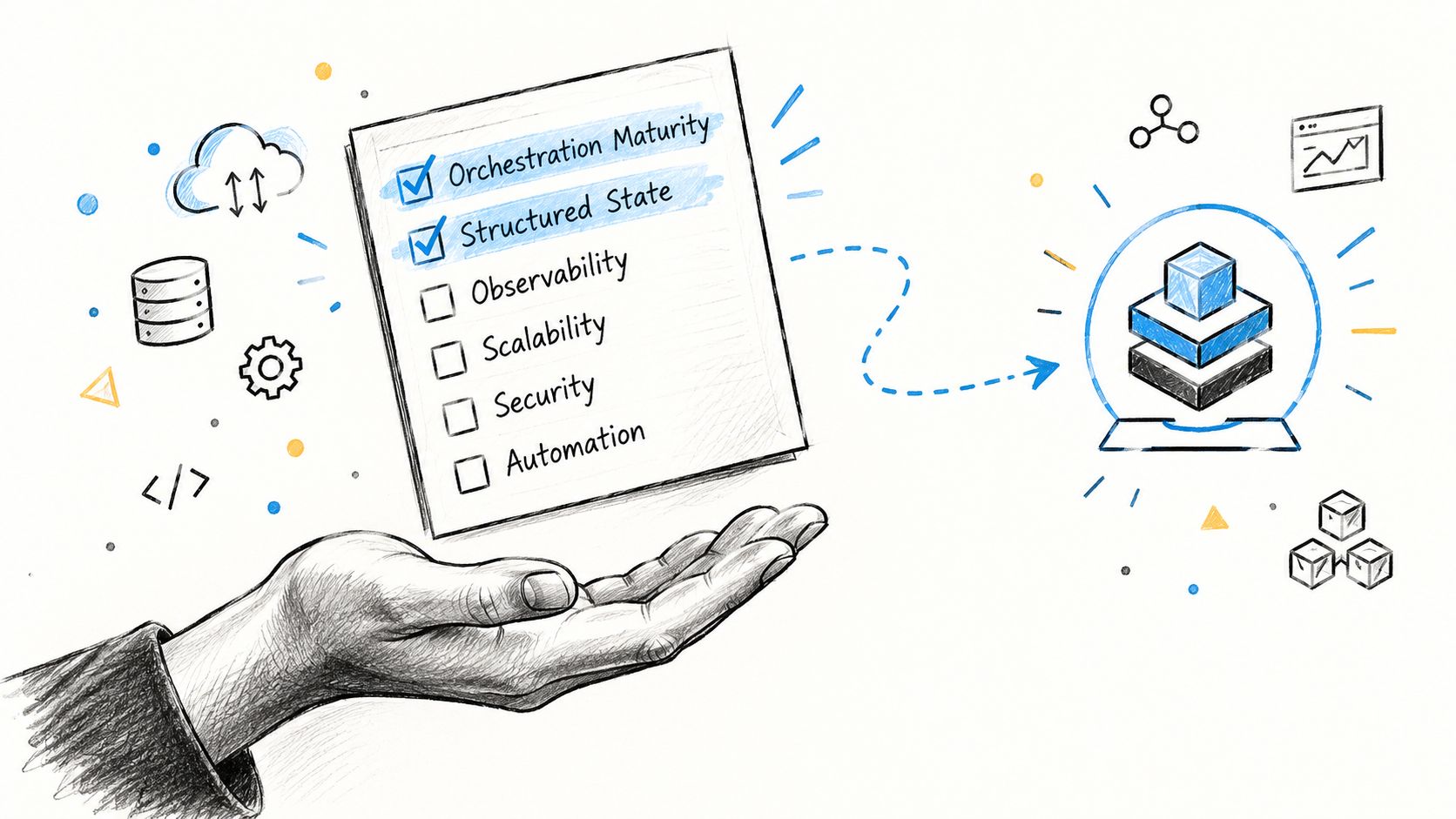
A fleet tool should pass a cold-handoff test. Stop Agent A after useful work. Start Agent B with no human recap. Can it find the current goal? Can it see the last decision? Does it know which tests failed? Can it tell evidence from terminal noise?
If the answer depends on a person copying chat text, orchestration is incomplete. The model may be excellent. The workflow still has a human-only edge, and every automated chain ends there.
File format is secondary. JSON can work. Markdown can work. SQLite can work. The requirement is a stable contract between processes, paired with recent execution context. That contract must survive a restart. Otherwise, recovery means starting the reasoning again.
For a more detailed view of orchestration framing, the internal note on AI agent orchestration frameworks gives the same separation from a different angle.

Model quality still matters inside each step. Orchestration decides whether those steps form a system. Check the state boundary before adding another agent or another pane.
AuricIDE is built for that seam. It runs CLI coding agents locally, keeps project state in .auric/project.db, and coordinates work across a desktop workspace. Visit AuricIDE and judge it by the same rule the article used, whether it can keep context moving cleanly between agents without putting the repo on a leash.