AI Coding Workflow That Hands Off Context Correctly
AI coding workflow fails at handoffs, not generation. Learn how AuricIDE chains pass terminal context and design reliable multi-step flows.
More automation sounds like less oversight. That is the usual promise. In practice, the burden moves into the handoff between steps.
A sound plan can still produce a bad review. The reviewer may never receive a key failure detail. Model speed cannot replace missing context. The workflow succeeds or fails based on the information passed forward.
This is not a guide to one AI agent or a roundup of coding tools. It looks at a multi-step flow where one agent session prepares the next. That difference matters. A randomized controlled trial from METR (July 2025) found that AI assistance made experienced open-source developers 19% slower on complex tasks in codebases they already knew well. Even so, they had predicted and later believed they worked faster. Automation needs measurement and review, not faith in speed.
Why does more automation not mean less oversight
Chaining agent skills does not reduce what needs watching. It moves oversight to the handoff.
A single-agent setup keeps context in one session. A chain divides the work. One skill plans, another changes files, and another reviews the result. The repository's combo decides the order. Every boundary becomes a decision point.
The boundary is easy to miss because the interface looks orderly: one step ends, the next starts, and the user sees a clean sequence. Yet the second agent never inherits the first agent's session. It gets selected terminal output. Not the full conversation, tool history, or earlier reasoning.
Practical rule: Treat every handoff as a small interface contract. Decide what the next step must know. Then make the prior step print it clearly.
The same handoff problem shows up in how these workflows get measured. Repo-level benchmarks now use long tasks across real repositories, not a single prompt, because a chain can look right at each step and still fail at the boundary between them. That setup tests the same handoff a chain has to get right: reliable navigation and checking across several steps.
The thesis is simple: chaining agent skills does not mean less oversight. The handoff needs clear design because each step sees only a cleaned tail of the prior step's terminal output.
What happens when the next step starts on stale context
The failure starts after a long test run. Step one prints many lines. The key failure appears early. Later logs and redraws push it outside the handoff window. The step still exits successfully, the chain starts step two, and the developer expects the implementation or review step to understand what happened. Instead, step two gets the newest tail, where the last lines cover cleanup and a partial summary.
The failing assertion has scrolled past the boundary. Step two now works from a stale assumption. It may inspect the repository and find the same failure. But it starts with the wrong explanation. The file remains available. The reason for opening it does not.
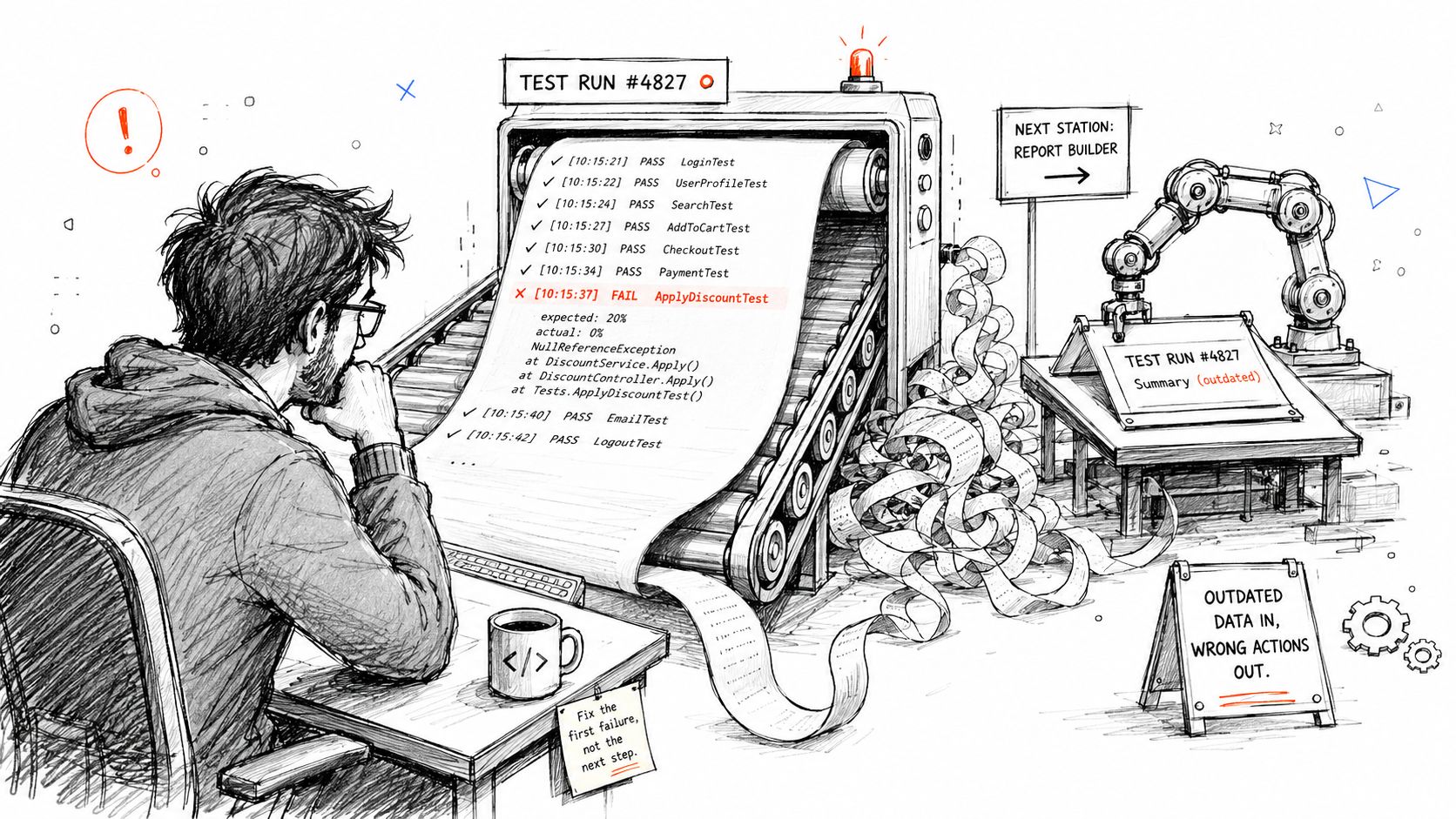
AuricIDE keeps a terminal tail capped at 2000 characters. It reads backward from the newest output and stops at a line boundary. Before the next prompt gets it, AuricIDE strips ANSI codes and filters interface chrome. It also removes duplicate lines. The cleanup cuts noise. The size cap remains.
A failing test near the end usually stays in the tail. A relevant design choice printed earlier may not. Focused output matters more than another skill. Shared project records exposed through MCP can hold information that a terminal tail cannot. The distinction is covered in how MCP servers support AI coding context.
How does an AuricIDE combo actually run
Combos run ordered skills. Each one happens in one project, and each new step gets a cleaned terminal tail added to its prompt automatically.
Combos have no built-in plan. A developer configures a fixed sequence for each repository. One project might use plan, implement, and review. Another might use a smaller flow for a focused change.
The sequence controls execution
Each combo tracks one current step index. All remaining steps wait. There is no branching. There is also no fan-out or fan-in. Execution stops when a step fails. A review step therefore does not run after an implementation step reports failure.
What generates that output depends on the skill. Each skill combines a prompt with a provider, model, and permission mode, and the provider decides which CLI writes the terminal text the next step reads. AuricIDE discovers skills by scanning configured directories. External CLI agents are registered as dynamic providers, one JSON provider configuration per CLI, imported under Settings → Agent and validated against a schema. Adding a provider needs no recompile or plugin API.
Agents run locally as PTY child processes, and AuricIDE reports success or failure from the process exit status, not a raw numeric exit code. That gives the chain a clear stop condition. Not proof the software is correct.
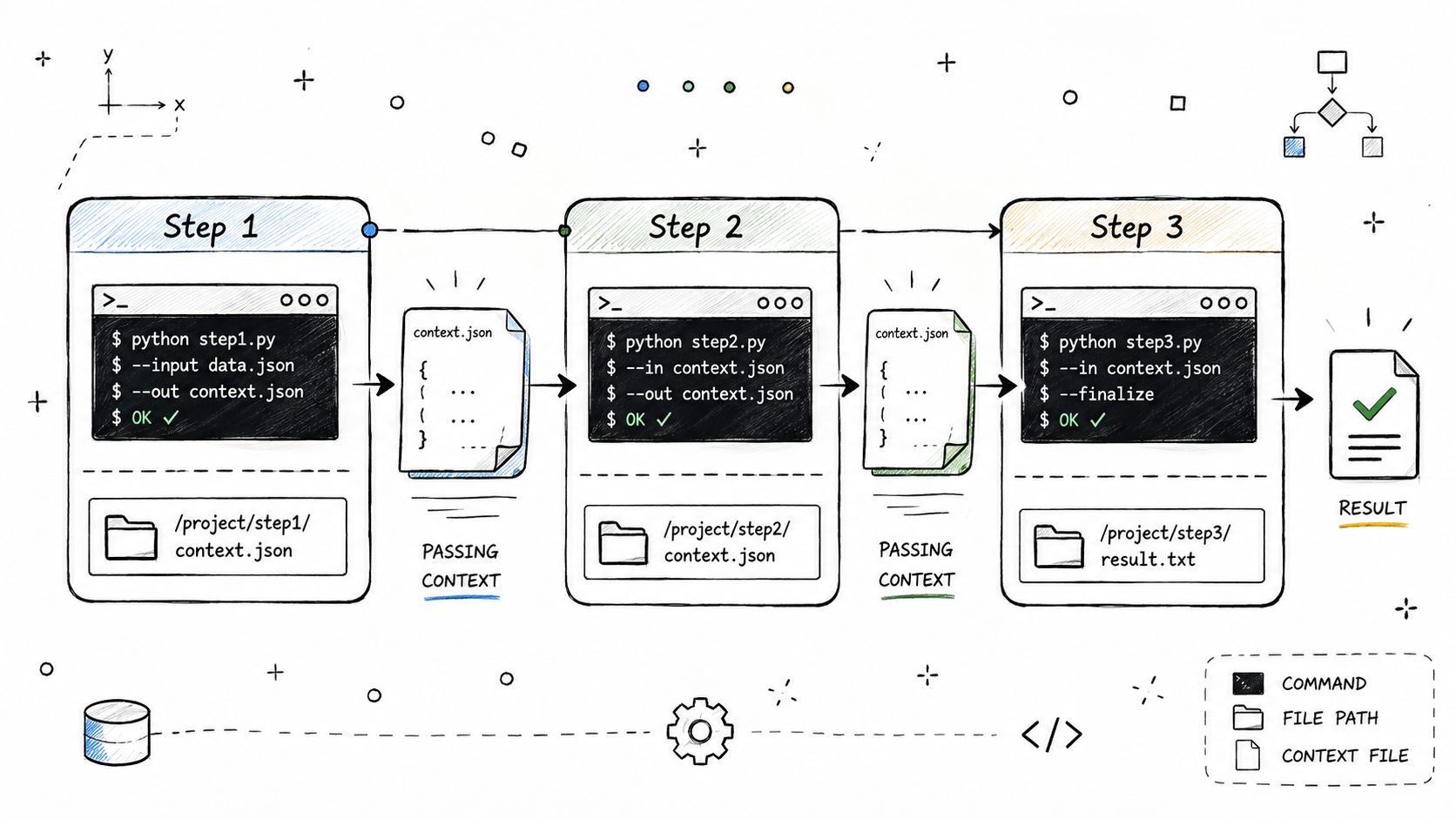
The terminal tail is a deliberate transform
The next skill receives its own prompt, followed by transformed output from the prior step, not that session's complete terminal history.
| Transform | What Happens |
|---|---|
| ANSI cleanup | Terminal color and control codes are removed. |
| Chrome filtering | Interface labels and display noise are removed. |
| Deduplication | Duplicate lines are removed. |
| Tail selection | Output is read backward from the newest lines. |
| Size boundary | The result is capped at 2000 characters and ends at a line boundary. |
This design works across different CLI agents. The handoff contains text. Not a vendor-specific transcript format. It can include a test summary, a changed-file report, or a clear review request. The prior step must print that information near the end.
A combo is separate from the shared project record. AuricIDE exposes goals, tickets, requirements, test cases, dependencies, and history over MCP. The terminal tail contains immediate process context. Record lasting decisions in project state or a repository file. Do not depend on an old terminal line. The related explanation of agent integration is available in the AI code agent guide.
What do you trade for this design
A predictable chain gives up branching flexibility for one inspectable path through one project.
AuricIDE stores project data in a SQLite file inside the repository. AuricIDE tells git to ignore that file. As a result, a clone brings no work record by default. The choice keeps workflow state local but limits portability.
A combo cannot branch, fan out, or fan back in after independent work. It cannot span repositories either. The sequence applies to one project. That makes the current step and failure boundary easier to understand.
Each handoff has one sender and one receiver. The route is easy to inspect. It is also limited.
Parallel, independent work belongs in the Fleet view, where repositories appear as pinned, app-like tiles and one attention metric ranks error above blocked-on-input above stalled. Fleet helps supervise separate work. A combo passes one project through an ordered sequence.
That difference guides selection. A combo fits work where step two depends on step one. It also fits work where step three must wait for verification. It does not fit unrelated tickets or cross-repository changes. Nor does it fit tasks where several agents explore alternatives at once. The trade-off is discussed further in the AI agent workflow overview.
What should you ask about any AI coding workflow next
Ask what crosses from one step to the next. Do not stop at model speed.
A useful answer names the boundary. It could be a full transcript, a selected terminal tail, a file, structured project state, or nothing. The answer should also cover oversized handoffs and failed processes. It should explain how later steps recover facts from earlier in the run.
This applies beyond AuricIDE. Verification can become a major bottleneck as generated code increases. Sonar's 2026 developer survey found that 96% of developers don't fully trust AI-generated code, while only 48% always verify it before committing. Faster generation does not help when reviewers lack the evidence needed to check a change.
The lesson is plain: handoffs define an AI coding workflow. Design the information boundary. Keep each step easy to test alone. Treat missing context as a workflow defect, not a prompt problem.
AuricIDE gives teams one local desktop workspace where they can run CLI coding agents as ordered combos, with provider-specific skills and a cleaned terminal tail passed at every step. Visit AuricIDE to examine the open-source workflow design and decide whether its explicit context boundaries fit the way your repositories are operated.