AI Assisted Coding: How It Works and What to Watch For
Learn how AI assisted coding works, where it helps, where it breaks, and what to verify before trusting the output. A clear guide for engineering teams.
At the deployment screen, consider a hypothetical failure: a senior engineer merges a feature branch written largely by an AI coding assistant. The code compiles. Local tests pass. CI stays green. After deployment, a downstream service rejects requests because the change omitted a field that the local fixtures never checked.
The Moment a Reasonable Pull Request Broke Production
The pull request looked reasonable because every check covered the implementation without proving the downstream contract.
The assistant followed the task. The engineer read the diff. Nothing looked strange. Yet the tests checked the wrong boundary: they confirmed that the producer returned data, without checking whether the consumer could use it.
That's the gap. A passing test proves its assertions. It doesn't prove every condition needed in production, especially when the generated implementation and its tests share the same mistaken assumption.
Review boundary: Treat a generated test as another change to inspect, not independent proof that the implementation is correct.
Think of a parcel with a clear label but the wrong contents. A scanner can accept the label while the recipient still gets something unusable.
The useful review question concerns the missing evidence. Which requirement describes the field? Which test checks its presence? Who verified that removing it was safe? The failure becomes easier to understand once the reviewer separates an assistant's completion message from proof that the change meets its requirements.
Why Faster Generation Is Not Faster Delivery
Faster generation doesn't establish faster delivery because someone still has to verify the change and repair mistakes.
The obvious explanation blames model quality. A stronger model might avoid the missing field. That explanation deserves attention, but it leaves the review boundary unchanged: an engineer still needs evidence that the downstream contract holds.
In AI assisted coding, review and verification carry most of the cost, and terminal speed overstates delivery speed.
That's a workflow thesis, not a universal research result. The evidence supports measuring both gains and costs.
Researchers ran randomized trials during 2022 and 2023, involving 4,867 developers; assistant users completed 26.08% more pull requests per week, according to InfoQ's account of the field study. That's a delivery signal. It isn't a guarantee for another workflow.
A separate trial with 52 engineers found that AI users finished a library task about two minutes faster, without a statistically significant speed difference, but scored 50% versus 67% on comprehension, as described in the coding-skills experiment. Debugging questions showed the largest gap.
Count accepted changes alongside the effort needed to understand and repair them.
An engineering team can therefore measure verified delivery throughput: accepted changes, with review time and later defects recorded alongside them. Generated lines don't answer that question. Neither does a fast first draft.
How AI Coding Tools Actually Run on Your Machine
In a local agent workspace, external coding CLIs run as child processes attached to a pseudo-terminal.
The desktop launches the selected CLI and reads its terminal stream. It determines success or failure from the process's exit status, rather than trusting a completion message. The underlying pseudo-terminal model supports that process boundary, although platform-specific handling is still required.
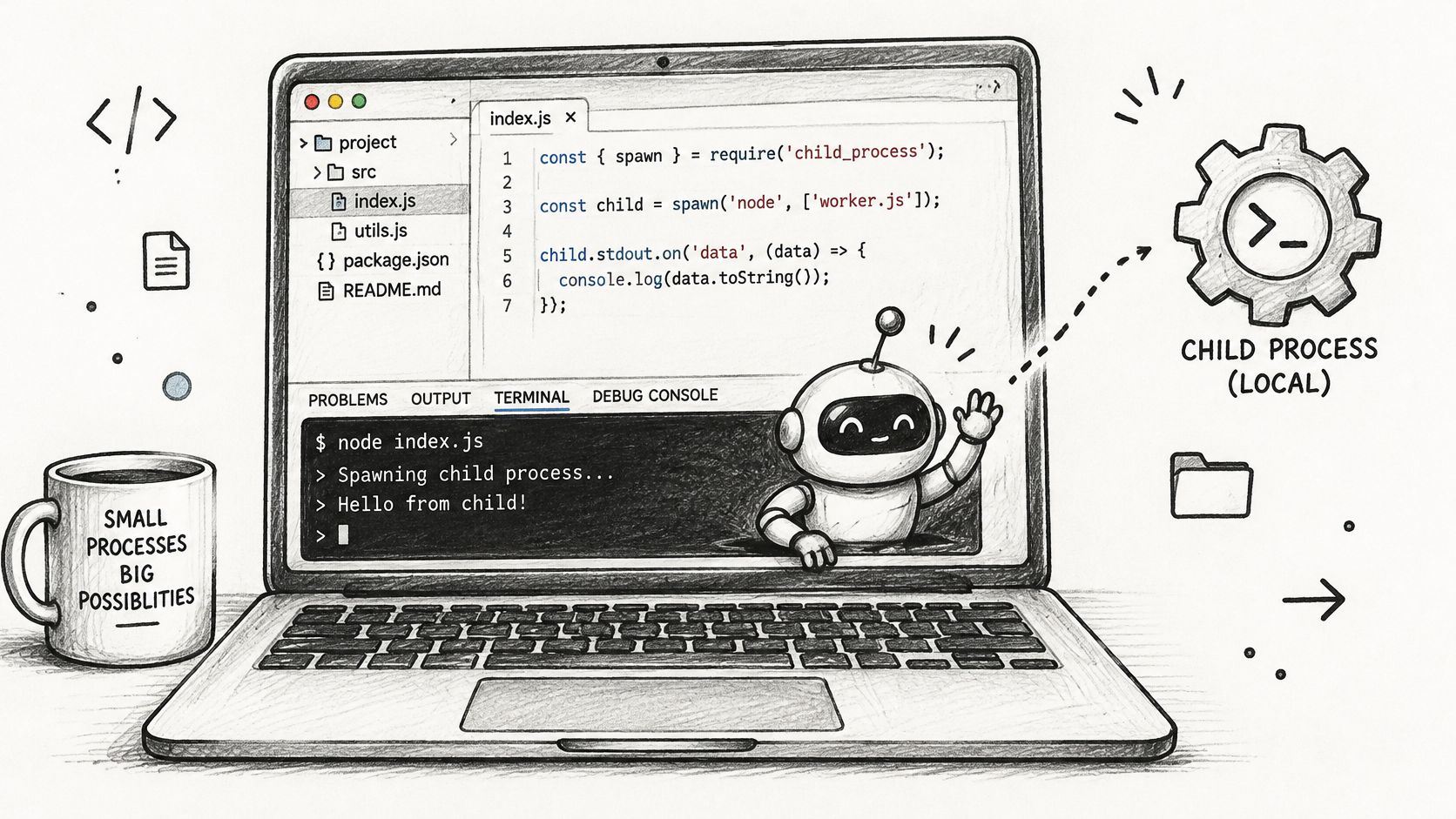
The local agent architecture separates registration from execution. Under Settings → Agent, importing a JSON provider config triggers schema validation. Registration needs no recompile or plugin API. Each CLI gets its own dynamic provider.
How does a skill become a handoff?
A skill combines a prompt with a provider, model, and permission mode. The application discovers skills by scanning configured directories. A chain, called a combo, runs skills in order.
- Launch: Each step starts with its selected agent and permissions.
- Handoff: The next step receives its own prompt followed by a cleaned terminal tail from the preceding step.
- Failure: An unsuccessful step stops the chain. Its completion message can't override that outcome.
The application strips terminal formatting, filters interface chrome, and removes duplicates before bounding the handoff. A reviewer should still inspect what remained.
A harness wraps an agent CLI. Dynamic providers register those wrappers; the desktop acts as a meta-harness. That separation lets one workspace coordinate different agents as a fleet without requiring a common conversation format.
Why Shared Project State Changes What Agents Can Do
Shared project state lets agents consult the same recorded requirements instead of relying entirely on a preceding agent's summary.
The workspace exposes goals and tickets over MCP, alongside requirements, test cases, dependencies, and history. The MCP specification defines the boundaries: resources provide contextual data, prompts provide reusable instructions, and tools expose executable operations.
Those roles matter. Reading a requirement differs from updating a ticket. Clients discover available operations through tools/list and invoke them through tools/call. Named tools and explicit schemas give agents a shared interface without requiring a vendor-specific integration.
How does that help a reviewer?
A reviewing agent can read the acceptance requirement directly. It needn't accept the implementation agent's summary of what the ticket meant.
For the hypothetical missing-field change, the useful record would state whether the consumer requires that field. A reviewer could then compare the implementation against that record. The same requirement remains visible in the human workspace.
Evidence rule: Preserve the requirement separately from the explanation of how the code supposedly meets it.
The project memory design stores project data in a SQLite file inside the repository. The application chooses local continuity over automatic sharing: returning to that retained file preserves the work record, while a fresh clone without it doesn't include that history.
That decision needs planning. Teams must decide how reviewers receive the relevant records.
What to Verify Before Merging AI Generated Code
Verify the behavior and its failure modes independently before accepting the generated change.
Confidence isn't sufficient evidence. In the 2025 Developer Survey, 45% said debugging AI-generated code was time-consuming, while 75.3% of respondents using or considering AI assistance said they didn't trust AI answers, according to the survey announcement.
Separate reporting found that 29% felt very confident detecting vulnerabilities in AI-generated or AI-assisted code, as covered in the AI code security report. These are survey responses, not defect rates.
A review stage needs explicit work:
- Check behavior: Run tests against the acceptance requirement, including the changed boundary. Inspect assertions as well as results.
- Inspect risk: Run static analysis. Review dependency additions and permissions rather than assuming generated choices are approved.
- Diagnose failures: Require an explanation tied to observed evidence. A retry that passes doesn't explain the original failure.
- Require acceptance: Use a passing verification stage or an explicit human checkpoint before advancing work. Human review remains separate.
The automated code review guidance fits that separate stage. Ordering skills alone doesn't prove correctness.
The fleet's attention metric ranks error above blocked-on-input above stalled. That helps an engineer choose where to look, but it doesn't replace review of completed work.
The Durable Choices Behind a Local, CLI Agnostic Fleet
The durable choice is to make handoffs inspectable, while accepting that portable handoffs preserve less than a full agent record. A cleaned terminal tail can omit earlier diagnostics or structured metadata that a native adapter might retain. The application accepts that loss to keep the interchange format independent of any agent vendor. Small tasks may not justify the coordination cost. Larger workflows still need an explicit decision about which evidence must be recorded outside the handoff. The sentence worth carrying to another tool is practical: accept a change when its required behavior has been checked, not when its author reports completion.
AuricIDE offers an open-source desktop workspace for coordinating local CLI coding agents, reusable skills, and ordered review chains. Visit the project to examine its handoff design, then try a generation-and-verification workflow on a contained change before extending it to deployment work.